
Huba de Graaff, composer
Hanna Hachula
Bowie Verschuuren
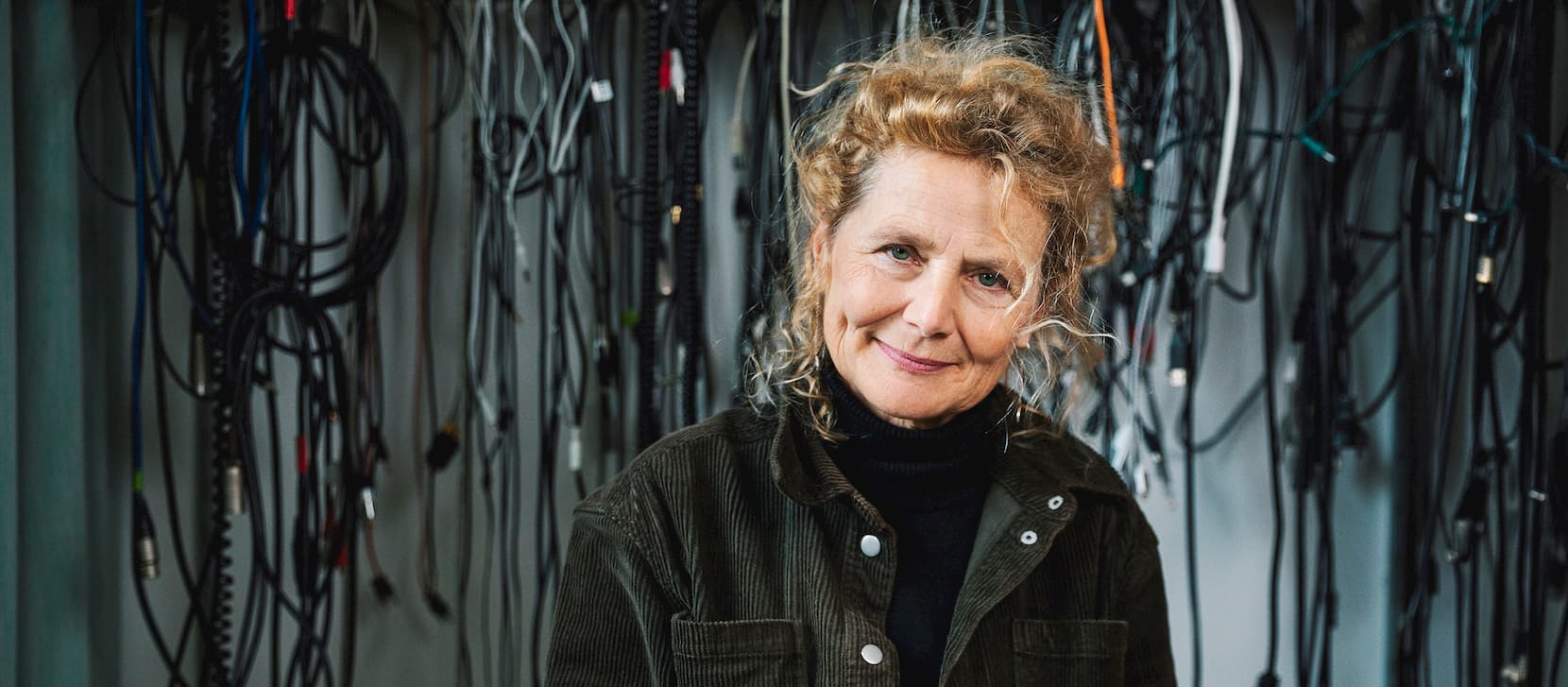
Huba de Graaff (1959) studied violin at the Sweelinck Conservatorium in Amsterdam, sonology at Utrecht University, and composition at the Royal Conservatory in The Hague. In the 1980s and early 1990s, De Graaff explored the possibilities of using new, mostly electronic media to unlock novel sound worlds. An example of this is Corenicken (1991), which employs electric violin, percussion, and various moving sound sources. In the same year, De Graaff designed the Japon Fuzz, a metallic dress full of electronics that produces sound through the movement of the wearer.
Although her compositions have had a theatrical character from the start, De Graaff gradually focused more on music-theatre works. In Hephaistos (1997) and Lautsprecher Arnolt (2003), she worked with the concept of the “loudspeaker opera,” in which most of the characters are portrayed by moving loudspeakers. For Lautsprecher Arnolt, De Graaff collaborated with writer/director Erik-Ward Geerlings and designer Bart Visser, with whom she founded the music-theatre collective WILco in 2008. Her collaboration with Geerlings continued even after the collective dissolved in 2015.
In addition to operas such as De dood van Poppaea (2006) and Diepvlees (2009), De Graaff has created a series of music-theatre productions in which the relationship between speech and song is central. Following Apera (2012) and Pornopera (2014), the “retro-opera” The Naked Shit Songs and the “synchron-opera” Liebesleid premiered in 2017.
Huba de Graaff, composer
Hanna Hachula