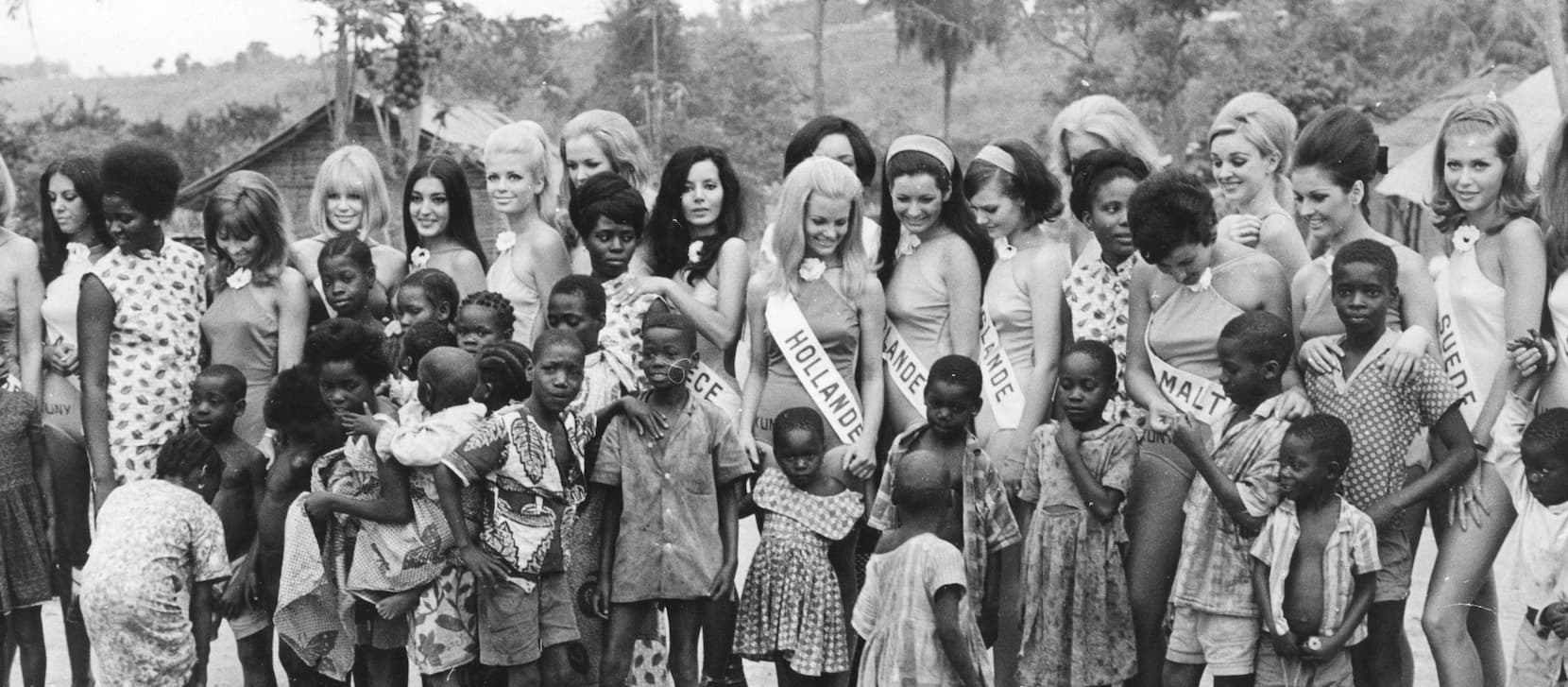
Miss Europe 1968 in Kinshasa

Faustin Linyekula, Théâtre Vidy-Lausanne, Studios Kabako

Copyright information:ZUMA Press, Inc. / Alamy Stock Photo

Twenty-one young white women compete for the title of Miss Europe 1968 in Kinshasa, the capital of Congo. A dictator sees the pageant parade as an opportunity to promote his regime. Meanwhile, a local population, newly liberated from colonial rule yet already subjected to a new form of domination, must find its place within these events. Choreographer Faustin Linyekula brings these stories together in Miss Europe 1968 in Kinshasa


Linyekula takes a tropical night in Kinshasa as his starting point. The city's youth gather, rumba music fills the air, and through dance the characters come to life: the white beauty queens, dictator Mobutu and his wife Elizabeth Tavares – first Miss Congo and hostess of the contest –, the young Congolese members of the "Bills" cowboy gangs of the era, and contemporary reflections of all these figures.


Linyekula weaves together opposites: glamour and violence, beauty and pain, freedom and oppression. He unravels old and new ideas about masculinity, femininity, and desire. The past proves to be ever-present, while the future remains uncertain, in the Congo of both then and now.

The Miss Europe competition to Kinshasa

The performance is based on a bizarre historical event. In May 1968, student protests and strikes brought France to a national paralysis. As a result, the Miss Europe pageant parade, originally scheduled to take place in Nice, could not go ahead. Congolese dictator Mobutu seized the opportunity and turned the situation into a publicity stunt by bringing the Miss Europe competition to Kinshasa.


At the time, Congo had been independent from Belgian colonial rule for only eight years. Mobutu had come to power through a coup d'état in 1965 and ruled with an iron fist. Just eighteen months earlier, he had publicly executed his political opponents. By hosting the Miss Europe pageant parade, a quintessential symbol of the West, he sought both international recognition and domestic legitimacy.


The event would become a precursor to an even larger spectacle: The Rumble in the Jungle. This legendary boxing match between Muhammad Ali and George Foreman took place in Kinshasa in 1974 and firmly established Mobutu on the world stage.


About the performance

In Miss Europe 1968 in Kinshasa, Linyekula explores the many layers of these events. As he explains, his aim is not to reconstruct history but to preserve Congolese memories of it. Those memories, however, appear largely absent. Congo possesses little archival material of its own about the pageant. Most surviving newspaper articles, photo essays, and television footage are European. Linyekula therefore searches for Congolese memories in what he calls “their last living repository: the body.”


Searching for Answers

Linyekula sets out to answer a series of questions. What did hosting the Miss Europe pageant mean for Congo on the international stage? How did it contribute to the cult of personality surrounding Mobutu? How did he transform the female body and the desire it evokes into a political instrument?

Were the young contestants aware of the exceptional circumstances in which they found themselves? Did they know that the people of Congo continued to live under oppression? Did they sense that they were being used to serve Mobutu’s double agenda?


The same questions apply to the women around Mobutu, who occupy a central place in the performance: Marie-Antoinette “Mama” Mobutu, his first wife and Elisabeth Tavares, Miss Congo 1968 and hostess to the European contestants. What roles did these women play?

And what about the Congolese people themselves? The women who watched white women parade in swimsuits and even in traditional pagnes? And what about the men, particularly the "Bills,"whose desires were manipulated. And finally: how do the echoes of these events continue to shape Congo today?


Collaboration

For Miss Europe 1968 à Kinshasa, Linyekula collaborates with Marie-Louise Bibish Mumbu and André Yoka Lye Mudaba.


Linyekula is responsible for the concept, choreography, and direction. Mumbu serves as dramaturg, paying particular attention to the position of women, both Congolese and European, during this historical period and to their perspectives on these events. Linyekula emphasizes the importance of this collaboration. The male gaze upon white female bodies is deeply embedded in the story and, as he himself acknowledges, “in our fantasies, including my own, whether I am aware of it or not.”


Read less

dates

Fri June 25 8:00 PM

Sat June 26 8:00 PM

Sun June 27 3:30 PM

prices

  • default from € 32
  • HF Young from € 24,50

information

  • French, Swahili, Lingala, Servo-Kroatisch surtitles: English, Dutch

  • Show duration to be announced

more info

Credits

concept Faustin Linyekula direction Faustin Linyekula choreography Faustin Linyekula dramaturgy André Yoka Lye Mudaba, Marie-Louise Bibish Mumbu direction assistant Pendeza Mulamba production Théâtre Vidy-Lausanne, Studio Kabako coproduction Holland Festival, Holland Festival, Kaaitheater (Brussel), Maillon, Théâtre de Strasbourg – Scène européenne