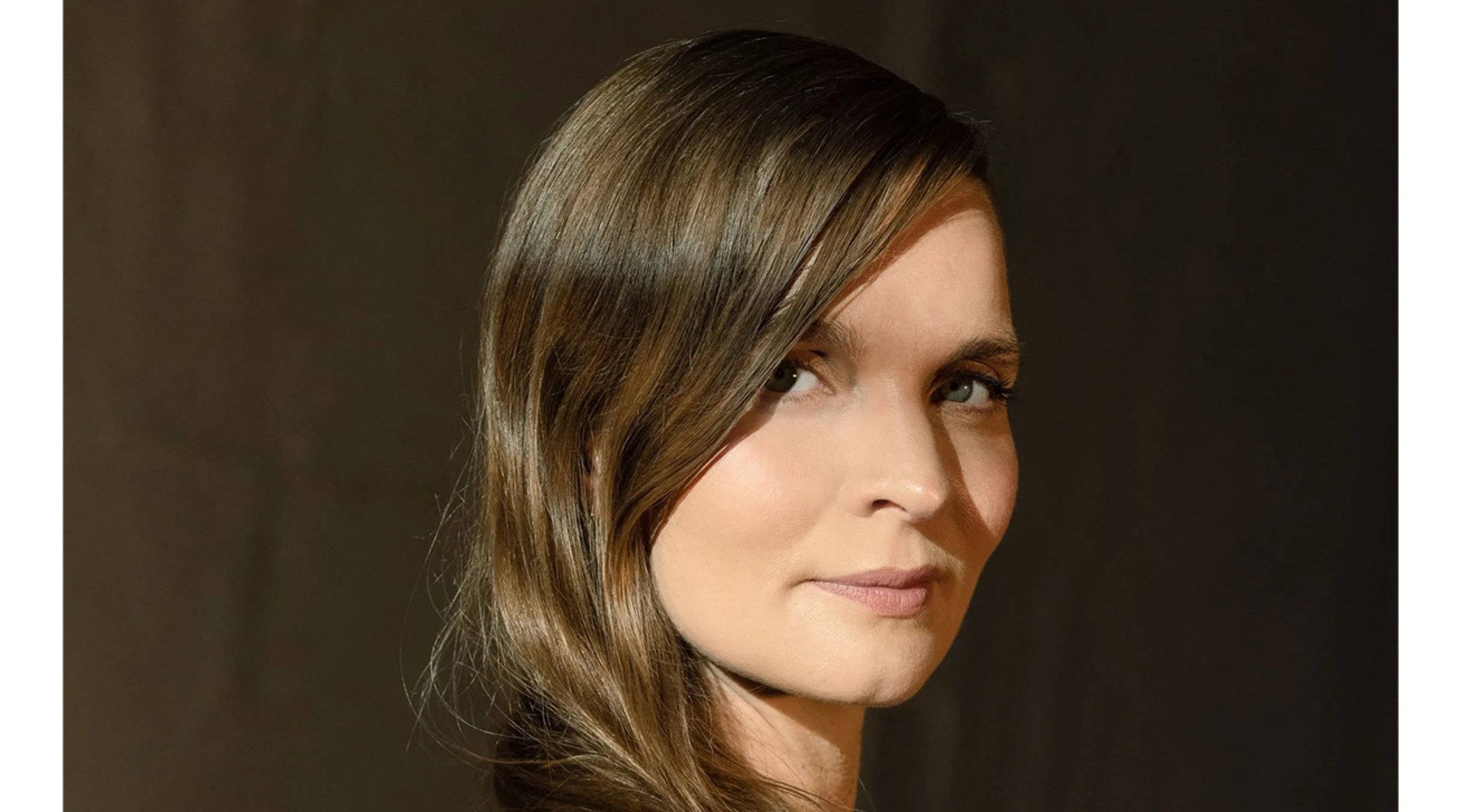
She says about this: ‘Because it has been twenty years since my first solo album, Mount A, was released, the concert will include compositions spanning two decades. While I was recording, I tried to sound like an orchestra all by myself, and I dreamed of multiple musicians playing alongside me. Now, twenty years later, I have decided to make that dream come true. In doing so, I am giving my younger self a birthday present in which she can hear her music as it is played by an orchestra.’
She wrote two pieces, Blind Sarabande and The Song That Never Was, co-commissioned by the Holland Festival and the Iceland Symphony Orchestra. She arranged all the music in the concert for the strings, synthesizer player, and percussionist of the orchestra, which will perform the works. She herself plays cello solo in a number of pieces. In doing so, she offers the audience a glimpse into her soul. It is not without reason that the concert has been titled Naermynd, Icelandic for close-up. It is one of four concerts with her music at the Holland Festival.
Hildur Guðnadóttir was born in Reykjavik in 1982, the daughter of a clarinetist and composer, and an opera singer. She began playing the cello when she was five years old and later studied composition and new media at the Icelandic Academy of Arts and the Universität der Künste in Berlin, where she has been living for the past twenty years. In addition to performing as a classical cellist, she plays in bands that utilize electronics. One of the instruments she plays is the halldorophone, named after designer and builder Halldór Úlfarsson, an electrically amplified cello with pickups under each string.
Guðnadóttir has more than earned her stripes with music for films such as Joker and Tár. Her music for Joker earned her an Oscar and a BAFTA in 2020. (The halldorophone also gained international recognition through Guðnadóttir, who used the instrument prominently in the film Joker.) She also received a Golden Globe and two Grammys for that soundtrack, one of which was for the menacing and dramatic Bathroom Dance, which is also on the program on June 15th. With the number of awards she received that year, she set a record for a female film composer. The music she composed for Tár in 2022 also won awards.
Her music is described as dark and possessed, but reduced to the bare essentials. Not a single note is superfluous. The dark, possessed atmospheres fit seamlessly with Joker and Tár, and with the supernatural whodunnit A Haunting in Venice from 2023. These films feature twisted, wounded characters capable of great evil. The Joker ended up in the world of crime due to childhood traumas. Lydia Tár is a manipulative conductor who is brought down by accusations of misconduct. Furthermore, Guðnadóttir wrote the music for the miniseries Chernobyl, about the disaster that occurred at the nuclear power plant in 1986. Selections from this music will be performed this weekend at Gashouder.
Apart from those ominous clouds drifting through the music, Guðnadóttir has a keen ear. It is no wonder that she names Jessika Kenney and Eyvind Kang as her favorite musicians. The two, who often feature in each other's projects, are attuned to minute nuances in sound and tone. Their music is stripped of all embellishment and excess, yet it is precisely in the resulting transparency that the smallest differences in coloring and intonation come into their own. It is music for sensitive, patient ears. According to Guðnadóttir, timbre also plays a prominent role in her own music. In an interview, she stated that time too is an important element of music for her. ‘I love music that slows down time the most. I need time to take in the smallest facets of a sound. I need time and space to let the music breathe. When I am composing, these elements are almost always present.’
The music by Guðnadóttir heard in Naermynd spans 17 years. Overcast comes from her 2009 solo album Without Sinking, on which she recorded deeply melancholic music. In Overcast, she creates layer upon layer with electronics, accompanied by an organist and a bassist in an extremely slow melody. Her father, Guðni Franzson, can also be heard on clarinet. She wrote the arrangement in Naermynd for strings and percussion. She plays the cello herself. Most recently, she has written Blind Sarabande, which opens the concert, and The Song That Never Was. In Blind Sarabande, which appears to be a reference to the music of Johann Sebastian Bach, she also takes on the solo cello part.
For the film music, she drew from Tár, A Haunting in Venice, and Joker. The Allegro from Tár is music that seems to portray the tumultuous state of mind of the conductor: Frantic, bordering on chaotic, only to settle briefly, after which a devastating storm rages through the music once again. The music could just as easily depict a tropical hurricane, with a relative and treacherous silence when the eye of the storm passes by.
Confession from A Haunting in Venice expresses emotions that contrast with those in Allegro: regret, thoughtfulness, introspection. A mournful melody moves slowly over bitter string chords, which only deepen into the lower registers towards the end, but ultimately have the soloist go forward alone. From the same film comes Pipes, originally written for a woodwind ensemble. Clarinets, a bass clarinet, and a flute alternate fast, almost stuttering chords with flowing lines. It is over before you know it. Guðnadóttir has arranged this for strings as well.
Meeting Bruce Wayne and Bathroom Dance come from Joker. The music is steeped in the sheer menace of gothic horror, echoing the grim cityscape of Gotham City, the city where the Joker and the young Bruce Wayne live. The sounds alluding to a meeting between the protagonist and Wayne at times evoke the image of an immense organ. In Bathroom Dance, Arthur Fleck assumes the persona of Joker, the disruptive criminal who uses his mental illness to instigate chaos. Wearing clown make-up, Fleck flees into a public restroom, gasping. Having calmed down, he begins a slow dance and assumes his new identity. The music is heavy, earthy, with a leading role for the cello. It is as if you are descending into the black recesses of his mind. This is the piece for which Guðnadóttir received a Grammy.
The program also includes film music by other composers: the theme from The Revenant (2015) by Ryuichi Sakamoto (associate artist of the Holland Festival in 2021), and Love by Mica Levi from Under the Skin. Guðnadóttir performed the cello part in the music that Sakamoto wrote for The Revenant shortly before his death. In the film, a fur trapper, played by Leonardo DiCaprio, travels through the American wilderness after being severely wounded by a grizzly bear and one of his companions kills his son. The ominous music embodies this journey full of hardship and violence. In its atmosphere it is akin to Guðnadóttir's film music.
The music that Micachu, the stage name of Mica Levi, composed for Under the Skin from 2014 was recorded by an acoustic ensemble consisting primarily of strings, but sounds synthetic due to the recording techniques used. In doing so, Levi mirrors the film's protagonist, played by Scarlett Johansson, an alien whose body is veiled by thin skin. The music in Love sounds seductive, exactly as the alien presents herself to the men who are her prey, but also radiates the coldness of the creature hiding beneath that skin. Micachu received an unprecedented ten awards for the soundtrack of Under the Skin. The music lends itself perfectly to an arrangement for string orchestra.
Furthermore, in the program Guðnadóttir has included works by three composers who hold special significance for her: Silver Streetcar for the Orchestra by Alvin Lucier, Feroce from Nymphéa Reflection by Kaija Saariaho, and Fratres by Arvo Pärt. Nymphéa Reflection (2001) is an arrangement that Saariaho made of her string quartet Nymphéa, French for water lily, inspired by the paintings of water lilies made by Impressionist Claude Monet. She imagined the growth process of the flowers unfolding, from the beginning as a germinating seed in the muddy bottom of still water to the unfolding of the flower on the surface. In Nymphéa, the composer added an extra layer of electronic processing she did of the quartet. She replaced this layer in Nymphéa Reflection with music for strings.
In Feroce (‘powerful’ in Italian), the second movement of the piece, she captures the germinating power of the plant, forcing its way from the mud towards the light. A high note from a single violin extends to the other instruments. The sound broadens, erupts, after which all instruments come into nervous motion, until the music culminates in a dance that recalls Stravinsky’s Le sacre du printemps, with its raw energy and rhythmic intensity.
Fratres (1977) was one of the first works with which Arvo Pärt broke a three-year period of silence. He had discovered a musical language in which he wanted to express himself, one of deceptive simplicity. Beneath apparent artlessness and soothing chords lie strict rules. Although Pärt left the instrumentation of Fratres open, the piece became known in two versions: one for violin and piano, and one for twelve cellists. Released in 1984 by the German label ECM, this marked the international breakthrough of the composer from Estonia. In the cello version, a two-part melody sounds over sustained drone notes. At regular intervals, a quiet tapping on the body of one of the cellos can be heard.
Most striking in Naermynd is Alvin Lucier’s Silver Streetcar for the Orchestra (1988). Lucier concerned himself with the interplay between sound and the acoustics of a space. ‘We have forgotten how sound propagates in a space and fills it,’ he once said. He often did this by combining acoustic instruments with a sine wave that moves up and down extremely slowly. He also worked with feedback by placing a microphone inside a small teapot, slowly opening and closing the lid. Silver Streetcar for the Orchestra was written for triangle, in a sense an imitation of the sound a tram driver makes to signal his approach.
The instructions for this work comprise two pages of text, in which Lucier describes how a percussionist investigates the acoustic properties of a triangle during a performance. There are five variables: tempo, dynamics, dampening, the point where the triangle is dampened, and where it is struck. These elements change individually and gradually. A stereo microphone amplifies the sound. By including this work in the concert, Guðnadóttir wants to share her sensitivity to nuance in sound with her audience.
In this way, the programme touches on one of the central themes of Holland Festival 2026: listening as an active and empathetic act.