When Cancel Culture Meets Brechts Problematic Baal
This article was originally published on the News & Features website of the Hong Kong Art Foundation. By Adam Wright, January 2026.
Baal—the first play by Bertolt Brecht—has posed a thorny challenge to the theatre world since its debut more than a century ago. The title character, a charismatic and rebellious young poet, is notorious for his misogynistic and violent behaviour. In Brecht’s play, Baal rejects social conventions, indulges in excess, and captivates the literary scene, only to descend into self-absorption and moral decay. By presenting Baal not as a misunderstood anti-hero or rock star, but as an amoral force, Brecht poses an unsettling question: what should we do with him?
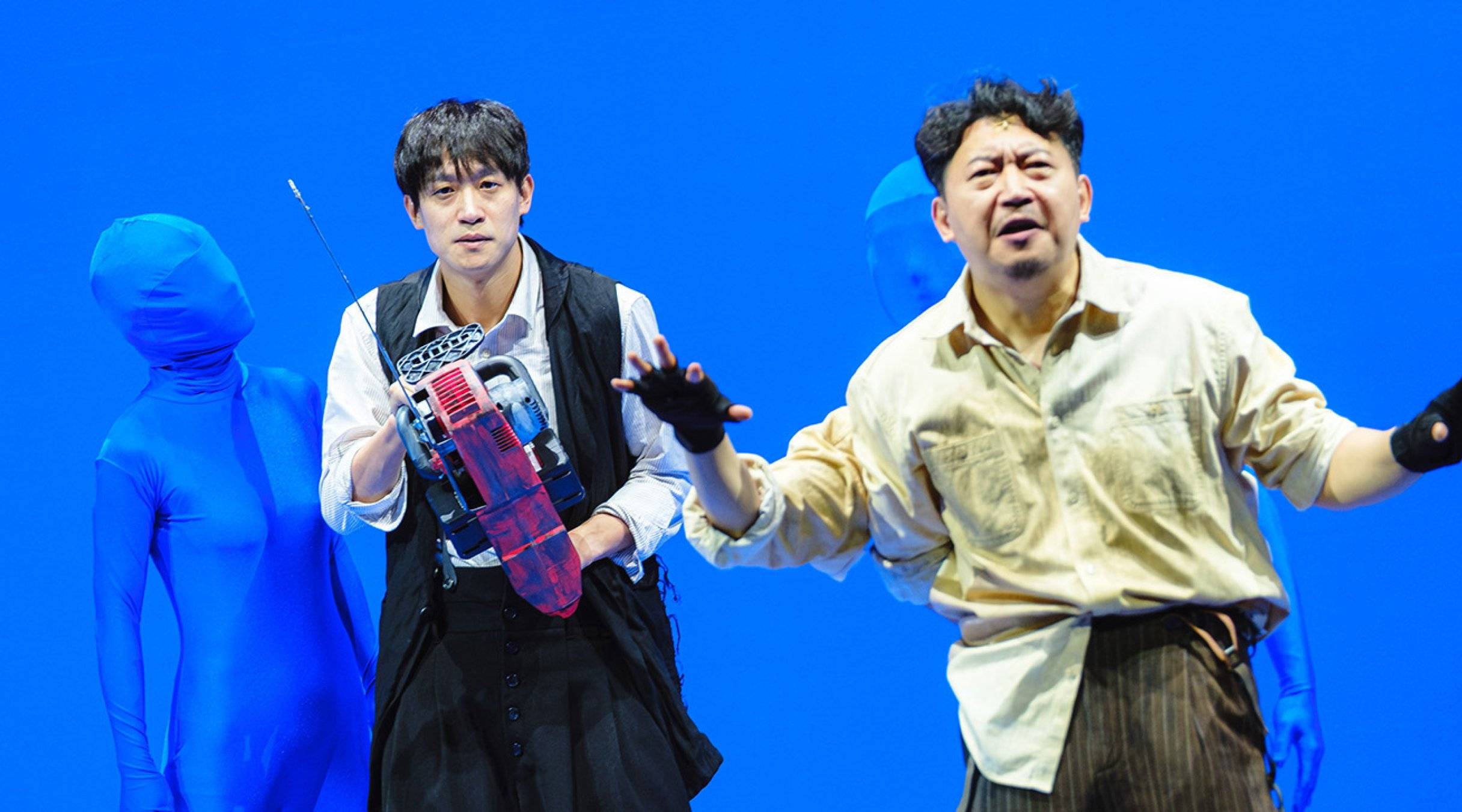
For Irish theatre company Dead Centre and their partners at the Beijing Repertory Theater, the answer is simple: cancel him. And they do not mean that figuratively—their adaptation literally erases the character live on stage.
While cancel culture may seem like a distinctly contemporary phenomenon, Dead Centre’s artistic directors, Bush Moukarzel and Ben Kidd, describe it as “a new name for an old idea”. “Every society has sought to expel people who embody what it believes is wrong with that community. From the cursed Oedipus sent into exile to a disgraced figure such as Harvey Weinstein, the phenomenon of ‘cancelling’ has a long history,” Moukarzel and Kidd told HKAF.
Dead Centre and the Beijing Repertory Theater are known for their inventive reimaginings of classic works, and Baal is a natural fit for both companies. Brecht himself famously spent much of his career revising the play. “He struggled with whether the character of Baal was useful to an audience. Was his antisocial behaviour instructive, or simply destructive? That creative struggle is fascinating because it raises the question at the heart of Brecht’s approach to theatre: what is art for? Can it change the world?”
Long before this Sino-Irish collaboration came about, Brecht looked to China and Chinese performers as he developed his famous Verfremdungseffekt, or alienation effect. “He sought to combine Chinese theatrical aesthetics with his European literary sensibility to create a new form of theatre,” say Moukarzel and Kidd. “Collaboration is the source of all creativity. Ideas, like people, travel across the world to forge connections and discover common ground.”
-
About the production
By Ben Kidd and Bush Moukarzel.
Baal is rarely performed for two reasons. First, it is not a very good play. Second, it has a problem at its core, its main character.
Written when Brecht was only 20, Baal tells the story of a rebellious poet-musician who rejects the conventions of bourgeois society by choosing alcoholism and anarchy. Brecht was creating a new kind of anti-hero, a character audiences would reject rather than sympathise with.
But it is a difficult balance to strike, and later in life the writer became concerned that he may have made his protagonist a little too appealing.
Viewed today, Baal’s charisma presents a major provocation: a misogynist, sexual predator and violent criminal, how can we justify telling the story of a man like that?
A Character Cancelled. A Classic Reborn.
Our response is to “cancel” Baal, not as an act of censorship, but as a creative intervention. On stage, two parallel realities unfold simultaneously. In a blue studio space, a company of Chinese actors performs the play in front of cameras. Above them, a video screen presents another version of the same performance, in which Baal himself has been blurred out. He is a problematic character, so the best way to stage the play is to remove him.
The production explores the way cancelled figures disappear from public life, both in China and in the West, as societies attempt to protect themselves from their transgressions. Every society depends on a form of exclusion, a way of defining what constitutes “good” behaviour and, ultimately, “the kind of people we are.”
As the story unfolds, Baal leaves the city behind and journeys into a cold, desolate forest, where he eventually dies alone. Following his path, we may begin to realise that there are very few characters who do not deserve to be blurred out. But we cannot ignore everyone.
A Unique Chinese-European Collaboration
Brecht’s fascination with China was profound, even if entirely imagined, he never visited the country. His encounter with the legendary Peking Opera performer Mei Lanfang in Moscow was transformative and would later become one of the foundations of his theory of Epic Theatre.
Our half-serious proposition is that this “problem play” can only be solved by a company of actors from the People’s Republic of China. Only they can truly capture the essence of Brecht and create an authentic Alienation Effect for contemporary audiences. The moral and political dimensions of art are central to both Chinese theatre and the modern Chinese state.
This collaboration therefore represents a final chance for this largely overlooked and deeply challenging play. Only the contemporary Chinese artist, we suggest, truly understands how to deal with Baal. More than that, only Chinese actors know how to create a perfect performance—one that displays only correct behaviour, for the continued security and prosperity of society. (At least, that is the theory.)
The production brings together an international team of artists, including Dead Centre from Dublin, award-winning Chinese set and lighting designer Jiang Han, French video designer Sebastian Dupouey, and a Chinese acting ensemble.
The production will premiere in Asia at the Hong Kong Arts Festival (19–22 March 2026, five performances), followed by its European premiere at the Holland Festival. A tour of Chinese cities, including Shanghai, Wuzhen and Beijing, is planned for later in 2026.