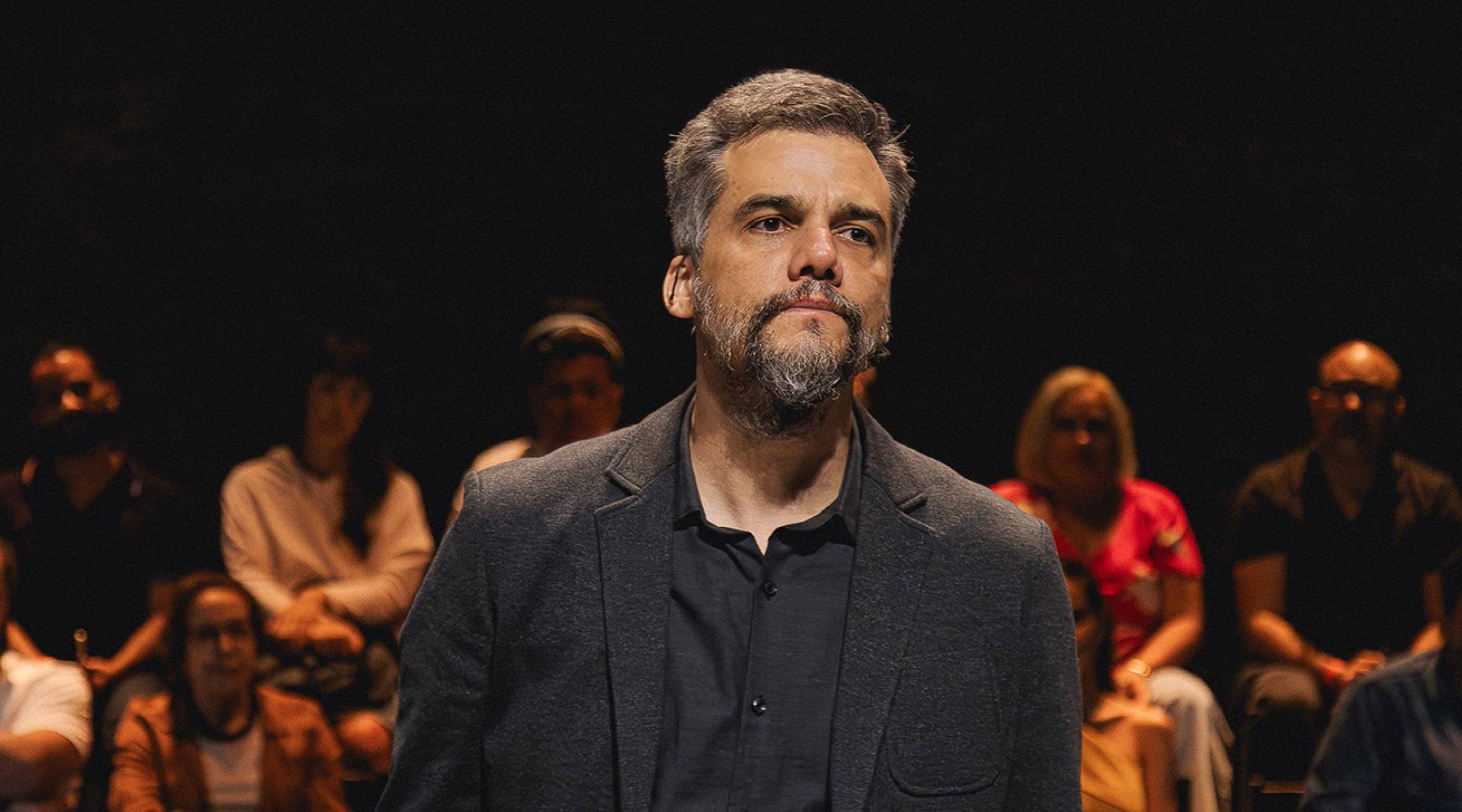
No one wants to be part of a randomly selected jury in real life. Although not an experience in Dutch courts, jury duty is a common civic duty across many nations. I myself have been called for jury duty in New York, although I never went. As a jury member, it is your job to take someone else's life into your hands, to sit for hours listening to a trial you may have no interest in or even a basic understanding of, and to take unpaid time off work for an undisclosed amount of time. Jury duty is something many people try to avoid; it is not considered an enjoyable civic duty, yet here the audience clawed to get one of the 50 possible chances to sit close to Wagner Moura, to be on stage, and to see the show in its most intimate circumstances. I showed up 45 minutes early to make sure I would get the chance to be part of the jury, but even after receiving a wristband, it was a random number of chance, and it seemed like today, chance was really on my side. Juror number 38, called on as the 9th of 11 jurors, I was left astonished at the luck I was given. The subject of this reflection landed right in my lap, along with the little black notebook given to each jury member. So, what is it like to sit on the jury for Wagner Moura and Christiane Jatahy's A Trial – After An Enemy of the People?
A Trial – After An Enemy of the People is an "imagined sequel" to Henrik Ibsen's An Enemy of the People, where a local doctor, Thomas Stockmann (played by Moura), tries to defend himself after whistleblowing about the toxicity of local bathing/spa water that is now harming the tourism industry of his small town. Moura and Jatahy's version takes place after the events of Ibsen's play, instead taking on the format of a trial. The audience plays the role of juror and spectator as the town's mayor and Thomas' brother Peter (Danilo Grangheia) tries to convict him as an enemy of the people. Thomas pleads his own defense with his daughter Petra (Julia Bernat) by his side supporting him.
At first, I was rather confused about what exactly it was that Thomas was on trial for and what the consequences of this verdict could be. I have seen too many TV shows about lawyers, and my pragmatic mind kicked in. As the jury, we were encouraged to write questions and give them to the foreman (Aline Olmos Steeler) to read aloud during the trial. My first question was this: what is Thomas on trial for? My reasonable brain thought it logical: if he was telling the truth about the contamination of the spa, how could he be the enemy? If he cared about the health and safety of his community and others, how is he the villain?
What became evident is that my rational brain was not what was needed to understand this trial, to be the jury. The trial was not literal; it was not held around jail time or money. It was a trial about cancel culture, about the truth, and in the end there was no winning for anyone, especially Thomas because, as he says in the opening of the show and in his final defense, "acabou a verdade" ("the truth is over"). It is not a trial over whether or not the spa has toxic water but whether the role of whistleblower is one punishable by the loss of one's life as they know it. It was in this theatrical space that the public was made to question the morality of such a modern predicament.
Many moments of this trial are given directly to the jury. The intimacy and immediacy of the testimony is felt so viscerally by the small audience on stage. The violence and the rage are near; they feel real, and at times the theatricality vanishes and all that is left is the emotional truth. This is where Moura, Grangheia, and Bernat shine, as they give many of their most impassioned monologues directly to the jury. Only feet away, the stakes become higher; their pleas for guilt or innocence feel directed at the jury. This is where the participation is strongest.
In contrast to these moments are the asides given out of character, frequently done in English by the actors as opposed to the characters. These moments are faced out to the audience; the actors break the fourth wall and fall back into themselves. It is a refreshing, almost Brechtian, theatrical technique that reminds the whole audience of the fact that this is a play after all. Moura expresses his enthusiasm about returning to the theatre, a place he sees as grand and influential. I am inclined to agree.
The participatory element goes further than just casting a vote. As a jury member there is a feeling of being watched, both literally as a member of the jury but also individually. I have never been good at hiding my emotions. No matter if it's disgust, sadness, confusion, or humor, it is written all over my face. I can't help but feel I am part of the show, both literally as the jury has the opportunity to vote at the end of the show, which decides the ending, but also as a barometer of compassion.
Especially in the end, Thomas' final defense is given with his back to the audience, all of his attention on the 11 people sitting in front of him and the camera (the only way for the greater audience to see his face). His tears are mediated by a stage and a screen, but to the jury it is only separated by a few meters of distance. I was moved by his words, by his emotion, but also by the fact that he was talking to me. It is one of theatre's most powerful tools: breaking the fourth wall and allowing us to forget for just one second that this is all a play.
Other than the contrast of intimate versus distant spectatorship, Jatahy and Moura also play with the multimediality of the performance. Pulling the audience from screen to screen with videos, live camera footage, audio recordings, WhatsApp texts, online interviews, as well as the live translations from Portuguese to both English and Dutch. The screen is a constant presence, another reality check of our modern world, and a nod to both Jatahy's and Moura's roles as filmmakers.
Everything we say or do can be recorded, captured, and then used against us when it is necessary. A trial is not only about what we say in the room but about everything we have ever said before. With modern technology, we often feel like truth is no longer in question; what we say is in black, white, and color. But as Thomas recounts in the end, there is no absolute truth. Instead, there are just versions of the truth; we each have one, and they are all different.
What does it really mean to sit on a jury? To have fate in your hands, but in the end, knowing that it is only relative. As much as the show clearly had some improvisation, its intensity and complexity left me with no doubt of its scripting and intense rehearsal process. The show had elements of choice, with the possible questions being asked and the voting at the end, but those moments were brief. Impactful as they were, I am left questioning how much was truly in my hands and how much was predetermined by the script. Leading me to question life itself: does the jury ever really decide? Or are the big cinematic ending and the possibility of change merely an illusion of choice?
What made Thomas an enemy of the people was speaking against the majority, refusing to submit to the masses, fighting for his morality, and speaking his truth. Does that make him a villain? Does that make him an enemy?
My personal verdict:
I do not think that Thomas Stockmann is an enemy of the people. I voted "NO" at the end. He is, however, selfish, self-righteous, and rash. It is his temper, his rage, and his emotions that put him in this situation. He is a flawed character and a flawed man, which leads to the trial being a moral one rather than one of fact.
What would he say about me swimming in the canals on a 40-degree day?