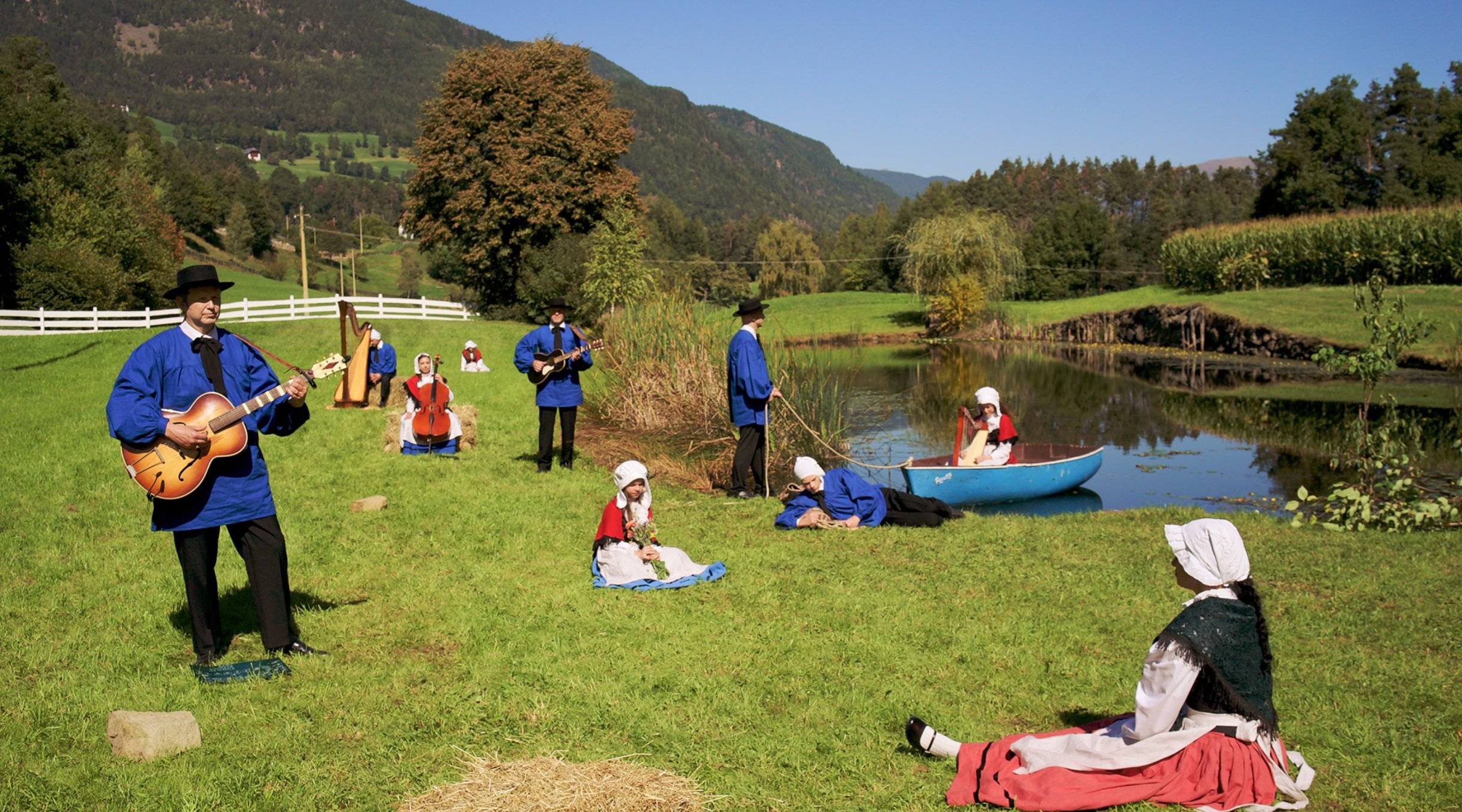
Sunday Without Love is, categorically, an Icelandic countryside postcard-inspired musical video installation, taking place in a fully darkened warehouse of Amsterdam’s Molen van West, an event venue occupying the historical landmark of the oldest working sawmill in the world, dating back to 1631.
A versatile artist of multimediality, Ragnar Kjartansson has long made himself at home within the video and sound installation form. The description of the piece at Luhring Augustine Tribeca in fall 2025 – an art gallery in New York, before its presence at Holland Festival – highlights that the work originates from a specific postcard, one that caught Kjartansson’s eye precisely because of an anonymous man holding a guitar. This origin, once known, somewhat deflates the curiosity around the choice of the postcard as form; the postcard is itself already a representation, a fragment of life captured and stilled in the visual medium of photography or painting. Such layering of representation raises an unease around the prominent flatness that the screen makes unavoidable, unlike oil painting, where depth and the spatial relationship between figures are rendered with tactile presence.
The stilled, fixed camera – a recurring device in Kjartansson’s practice, which can be traced back to his 2008 video installation It’s Not Your Fault – deepens this dissonance: the audience reaches toward the image while the image holds its distance. This tension extends into the work’s handling of time: the roughly twenty-minute loop, the bodies stilled and grounded in place, singing and playing, to the point at which one can no longer distinguish who is doing either.
If not driven by a desire to be fully observed, why this duration? The stillness seems to invite multiple viewing angles, yet deliberately foreclosed them, leaving the weight of the piece resting instead on the repetition of its compositions and lyrics.
For several moments in the darkness of Sunday, watching shadows of people hesitantly choosing where to stand or sit, I find hope and anticipation in the unarchived interactions amongst audiences – a desire to stay physically closer, whether by lying down together or leaning toward one another while sitting. The space feels inseparable from what lies just beyond it – the lawn beside the sawmill, invisible in the dark. When the lyrics repeat their advice to “stay on the ground,” I accept the invitation literally, lying down in hope of placing myself in that lawn rather than in the darkness I actually occupy.
The fully enclosed installation, with its music seeping constantly into the open-air mill surrounding it, holds its audience in a fragile, uneasy relationship with the work: less invited guests than intruders, aware of how little can be completed, touched, or answered on the other side of the screen.
Located on the other side of the mill, in the waterfront warehouse, Your Eyes in My Head by Laurie Anderson – a headset-based sonic experience – both invites and intrudes upon one’s personal space, as if offering to share a private listening. The fully glassed space creates a stark contrast, where an audience is free to gaze outward toward the river or the mill at will. The intimacy of the gesture is worth highlighting: sharing another’s headphone is a mutually intimate act, so personal that it demands a personal response. The installation sustains this intimacy through its content with everyday sounds of objects, large structures, and physical movements such as brushing teeth or the grinding of factory machinery, layered beneath a female voice that scatters fragmented, repetitive thoughts, close in structure to poetry. Taking the artist’s seeming intention of being one of presence, of staying in the moment, I will reflect along those lines.
What ties the two installations together is an interdisciplinarity of “form,” one that quietly resists a notion I adopted too early in my engagement with the arts: that “content” dictates form. The claim, most forcefully associated with Stephen Sondheim, still holds a certain authority. “Dictate” may be too strong a word, yet retrospectively rebellious – to interrogate it fully would require a separate discourse. This notion, however, remains reflectively true here, for audience perception operates autonomously, shaped by thought and association, not necessarily by one’s physical appearance. The danger of holding too tightly to formal belief is that it turns art into a target, rather than a weapon targeting the socio-artistic conversation it aims toward. This raises a structural question: what “is” the content of these installations, when their form so insistently claims the foreground?
One answer lies in a recognition that is still, perhaps, underacknowledged, is that installations as such belong to the performing arts. If performance implies a live, present act, here, it is the audience who supplies it, whose bodies and attention allow the work to exist in the moment at all. This, perhaps, resolves the question of “content:” it is the audience’s body. The logic holds, both practically and metaphysically. Yet something remains unsatisfied – a missing reciprocity, a conversation in which only one side is heard.
During my time with Your Eyes in My Head, a magpie moves across the mill – landing, departing, returning – and becomes, almost without my noticing, my primary visual anchor. Every sound arriving through the headset – the trains, the factory, the brushing of teeth – seems, for a moment, to be produced by the bird, as though it is both the source of the noise and its only listener. Yet there is a detachment at work: the wind, the trains, the sounds in the headset are all held at a remove, blocked by glass, unreachable as if screened, like Sunday.
In the end, however, the mill remains, and so does the magpie.