As I approach the rather majestic vision of the Molen Van West, I stop by the bakery next door to get a coffee and enjoy the view. I sit on a little chair outside and gaze at the windmill in front of me. It may be a normal sight for Dutch people, but for me it is very exciting. I squish my feet into the pebbly ground beneath me and the sound reminds me of beach holidays in England. Especially because there is now a drizzle of rain and the wind is sweeping my hair across my face as I am trying to note this feeling down.
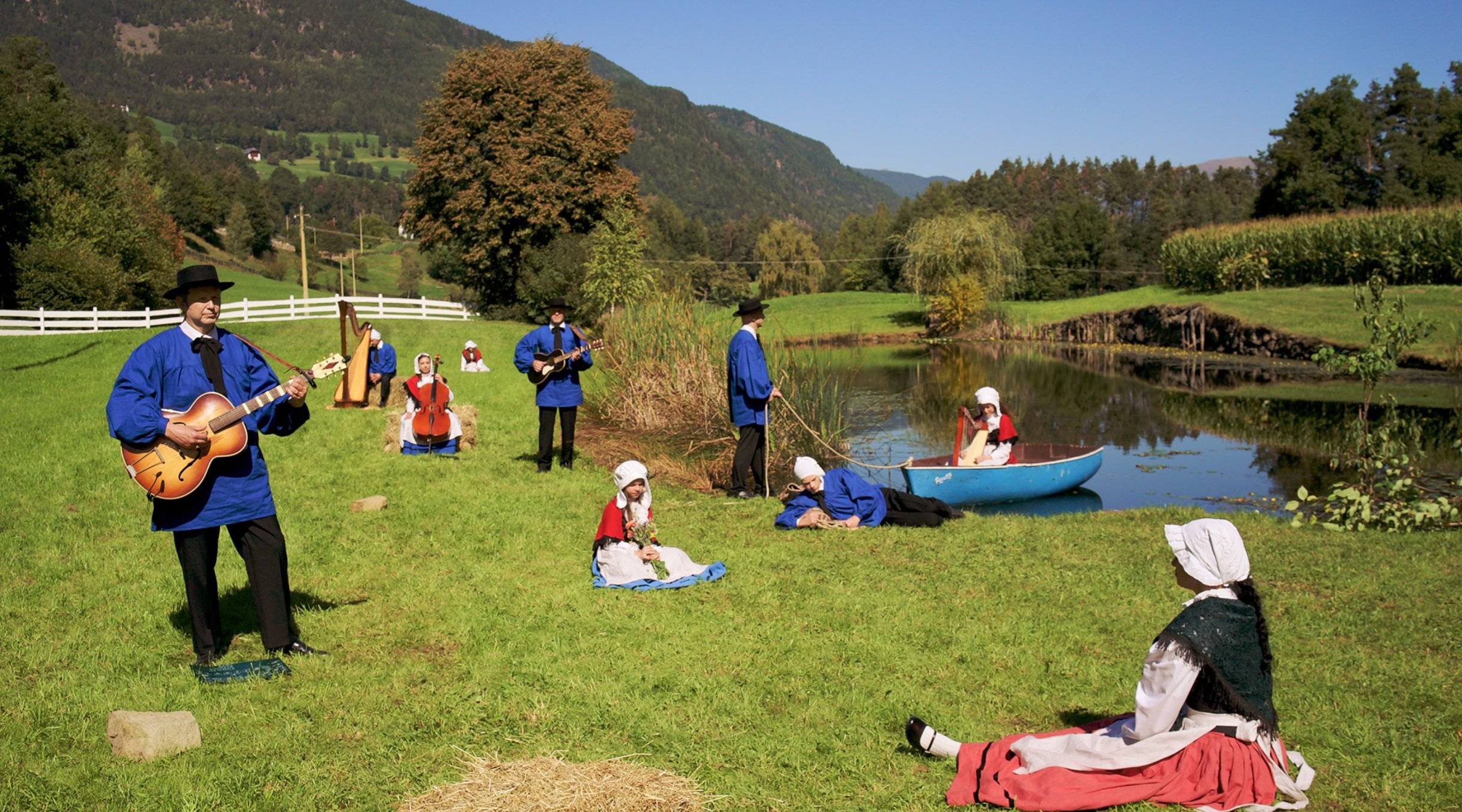
Having finished my coffee, I wander, a little nervously, into the first installation, taking place in one of two barn-like structures. This one is dark, and very long. At the entrance there is an explanation about the mid-twentieth century postcard that Ragnar Kjartansson’s Sunday Without Love was inspired by. This video performance is a kind of re-enactment of that postcard, this time with sound as well. The nine musicians in the image, all of different ages, play a song with the repeated refrain, ‘You must learn to live without love.’ The music was adapted from Rocko Schamoni’s comedic 1996 piece, “Ohne Liebe Leben Lernen’. I can see the traces of this humour reflected in front of me; there is something absurd about watching nine people dressed in traditional clothes in an undisclosed rural location playing a mix of modern and classical instruments, all while barely making a facial expression. The lyrics are heard over and over again for around 20 minutes, sometimes with an added, quiet harmony sung by the little girl at the front or an extra string from the cellist who is further away. The video looks like a still life painting, and it seems to play with perspective. There is a real sense of nostalgia and longing for a past that is in deep juxtaposition with the digitality of this installation. The construction of this performance, using the new media format of video, projected against the edge of a barn, means that there is an extra barrier to entering this bucolic world because the actors are not here with us, on the same ground. The video is situated at the end of the long wooden building, and apart from a few other audience members, I am alone in the dark. But I am also in a barn, next to a windmill, with pebbles on the ground, in the urban city of Amsterdam. I find myself feeling a sense of unease.
Still with this unease, I go into the other barn next door, where Laurie Anderson’s Your Eyes in My Head is taking place. This barn is light and airy, but similarly long. Before I am led to a free armchair, where I put on the allocated headphones and press a green button, I learn from the explanatory placard at the front that this audio performance by Laurie Anderson plays with the physical and spatial elements of listening. In an attempt to explore what it would be like to be inside someone’s head, the American artist uses binaural sound to create a truly three-dimensional experience. This is a uniquely individual and intimate performance, though there are several other audience members in the room with me, all listening at different times.
I am in a slight daze from the previous barn, so as I take my seat, I find myself staring out to the canal in front of me, enthralled by the action that is happening. Across the water are several benches, which I am pleased about, as I think Amsterdam should have more benches. There are three women sitting on one bench, and either side of them two men, both sleeping. It is 14.00 on a Wednesday. One of them was just having a quick nap, as he gets up and leaves shortly after. The other stays there the whole time, as do the women. I make a plan in my head to go and sit on the benches after this, maybe with another coffee. As I am thinking this, a voice from the headphones, that feels like it is right in my ear says something like, ‘it’s all in your head… isn’t that lonely?’. It frightens me a little, and pulls my focus inwards again, to the sounds I am hearing from the headphones. This phrase is repeated several more times during the audio performance, quite similarly to how, ‘you must learn to live without love’ was repeated in the last installation. I start to feel a little agitated. First, I was told I need to live without love, and now I’m being told that I’m lonely. Stark words for someone who recently moved abroad. As I’m thinking about this, I hear another startling sound. This time it sounds like someone running on a pebbly surface. It gets louder and louder as it feels like the person is passing behind me. I look to my right as if I will see this person but instead, I see another audience member in their own armchair, grinning to themselves. I am unsure what there is to grin about, but I am happy for them. The sound of the running and the pebbles flying about is jolting and feels intensely close to me. I try to close my eyes for a second, in an attempt to escape this feeling, and then I remember my pebbly beach holidays again. I think about the sound of my toes sinking into the individual stones and pressing down a mug of tea to the ground to try and balance it. I always end up spilling it anyway. I hear someone gulping tea or water in my left ear now. They are gulping with real urgency, maybe even fear. It feels uncomfortable and personal, like I shouldn’t be listening to it. I shiver slightly in my seat.
Then they repeat the words again, and for the final time, ‘it’s all in your head… isn’t it lonely’. And I start thinking back to, ‘you must learn to live without love’. You must learn gradually, even slowly, like the lyrics that are repeated again and again. The bucolic countryside of the postcard is fading away, and we are all living in an increasingly lonely world, it is true. But for now, I still have my lovely pebbly beach, and I think I must resist learning to live without it.
Inside my head, I thank Ragnar Kjartansson and Laurie Anderson for reminding me.