PART I
LIGHT
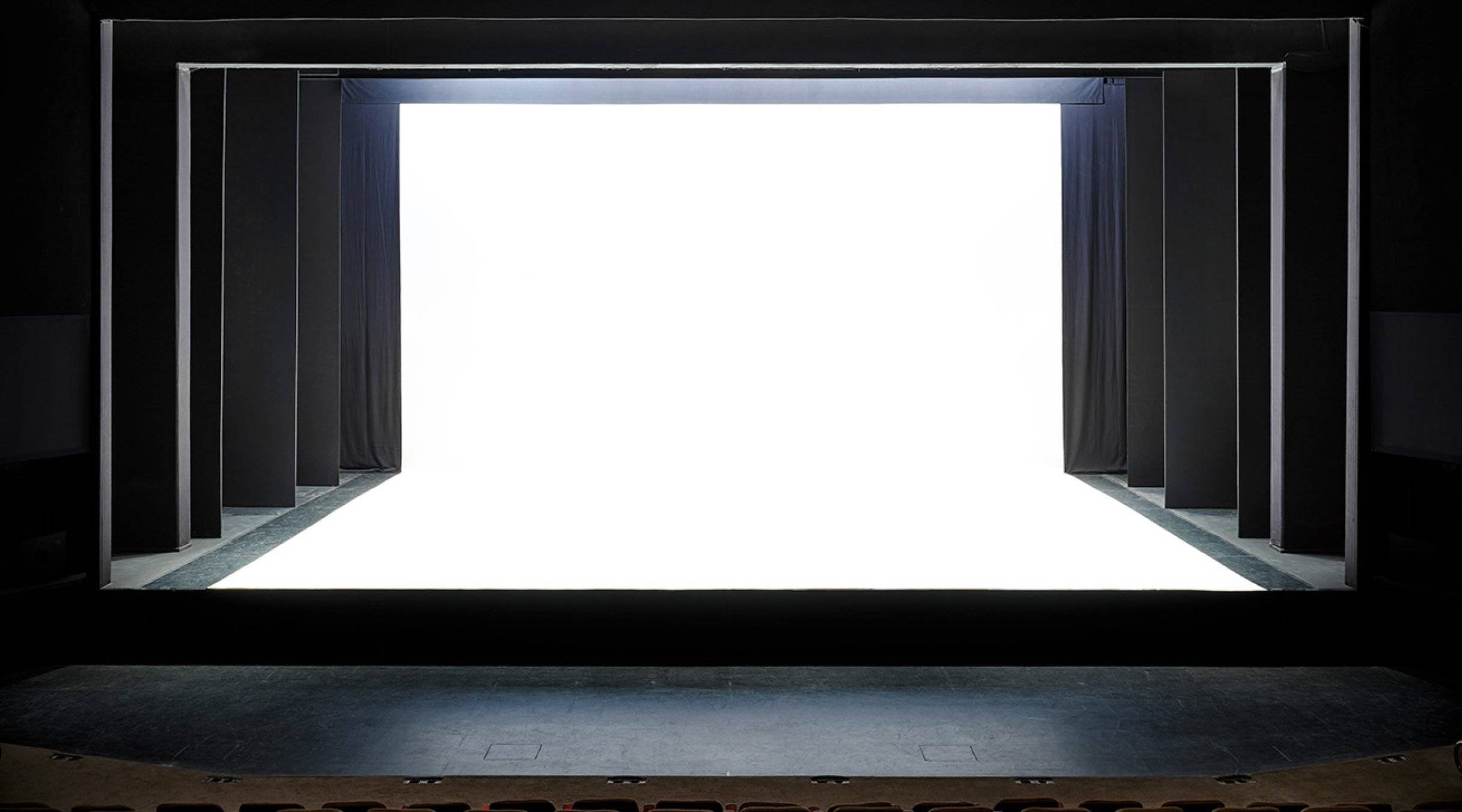
We are presented with a lit, empty stage. Sitting in the auditorium, we are lit in the same manner. There is an announcement to put our light-emitting devises in the opaque bag handed to us at the door, so as not to disturb the experience. The doors close. Nothing happens. I see people looking around, looking at others in the room, there is an anticipation in how people are looking, and an uncertainty as to what is going to happen next. The shuffling and coughing and rustling all become part of the scene, and there is an awareness to the presence of those around us, as we wait for some kind of action to be played out in front of us.
The sound of buzzing static plays quietly, like a light dimmer turned all the way down, almost unnoticeable at first. And then slowly, very gently, the lights begin to pulse on and off, moving across the audience and the stage.
This extension of the moment between the doors closing, and the first action to take place has set the ground for the performance to play with the assumptions on what is possible in a theatrical environment.
From then we are brought on a journey using only white light of different brightness that plays with our physical experience of the different lighting states and shapes that are in front of us, inviting imagination and feeling to experience this journey.
An eye watching us.
A cinema screen that seems to flick between us, the audience, watching the screen, and with the
inversion of the light and shadow, suddenly we are the ones being watched.
The static and drone vibrating my chest.
A circle flickering, almost touching my face.
A diamond that rises in the auditorium as a ghostly apparition that keeps on coming towards us.
A bar of light.
At times, we plummet into total darkness, and I am suddenly alone.
My wandering mind on a journey guided by the sound and light.
A bright, unpredictable flash of light, demanding attention, lingering as it dims.
At this point, the rest of the audience once again becomes visible. People turn their heads, covering their eyes, as the surprise of the flash is so unexpected. I am now again in the auditorium surrounded by the other audience members, who were not present with me in my mind just moments ago. The sound had stopped, allowing once again for the silence to be filled with the reactions and movements of the audience, once again placing us as a n physical part of the experience.
This unpredictability of the lights and sound created a landscape that allowed for the play between the distance and immersion of our physical and mental presence. I never knew what was coming next; what shape, what entity, what sound, which managed to both boldly claim our attention, and also give us the space to allow the lights to wash over us, almost creating a space for a trance-like state. This performance plays at the boundaries of what opposites can evoke, how close can the audience feel, how much distance can be created, where does is our attention demanded, and when can we drift in a parallel journey?
PART II
SOUND
In the introduction, dramaturg Bart Van den Eynde spoke about how the creator of the piece, Germaine Kruip, moved away from theatre performances and primarily showed her work in galleries and museums, before returning years later.
While watching the show, my mind often wandered along with the journey, and l began thinking about what would this experience be like in a gallery. Could the absolute darkness, the concentration, the tricks of the depth of light, and the intensity of the sound be the same in a different environment? I felt as if the shuffling in seats, and coughs and inhales and exhales surrounding me were as much a part of the performance as the light. However the control over the conditions in the theatre were able to create a fully immersed experience for the audience. Sitting in a theatre with a group of people who are there just for this presentation, instead of wandering in and out allowed for a complete immersion, and the communal feeling of being in this here and now moment together.
The second part of the performance furthered this feeling of human togetherness by adding four performers onstage, who played brass bars that came down from the rafters with drum sticks. As the lights in the previous section, this percussion was unexpected and playful, and explored the limits of what could be done musically with these instruments. At times, the music was intense. At others, it was soothing, once again allowing for a drifting to meditative rhythmic sounds, and a sudden burst of energy that brought us back together. Although this music also allowed for an emotional journey, it also demanded our attention through the creation of musical patterns and beats, being both repeated and broken, never allowing for an extended respite. I wasn't sure if my attention was more concretely held because of the performers, or because of the rhythmic percussion.
At one point, the back curtain rose up, exposing the brick wall of the theatre and a door (I imagined) to the outside world. I wished so much in that moment for the doors to be flung open, and for the connection of the scored sound and artificial light to be met with the natural light and sounds of the outside. I felt that our presence was necessary in this performance, and I really wanted the uncontrolled outside, to be invited in too.
PART III
END
There was a trepidation as to when we should clap. The brass bars flew back up into the rafters, the stage and the auditorium were both lit; the performers in front of us stood still and firm. The lighting did not change, a usual signifier for an audience but in a performance that played with light as one of the main elements maybe we would have thought it was merely a continuation of the performance. It did become apparent that this stillness, this quiet, that yes, it was the end.
This piece explored the boundaries of sound and light. This created an environment where my mind was allowed to wander, creating a space for imagination and wonder, which extended beyond the performance. My attention was allowed to journey on its own, and then demanded when it was needed, creating concrete moments of togetherness in the show.
I left the theatre, a little dazed, having been stretched and pulled through light and dark, through quiet and sound.