I am on the ferry from Amsterdam North, heading toward Central Station and from there to
the Frascati theatre. Holland Festival is presenting a work called Atomic Joy, which is a dance
performance by Anna Pi (Brazil/France) who is a choreographer,
visual artist and researcher.
An atom: the smallest unit of matter. And then joy. Atomic Joy. Am I being promised joy? In
some atomic microscopic or even cellular level. How uncomfortable, at least for someone
shaped by a Finnish mentality. For Finns, displaying joy, or even performing it, often feels
awkward. It can so easily come across as false. The very premise makes me laugh. Why are
we so reserved? Me included.
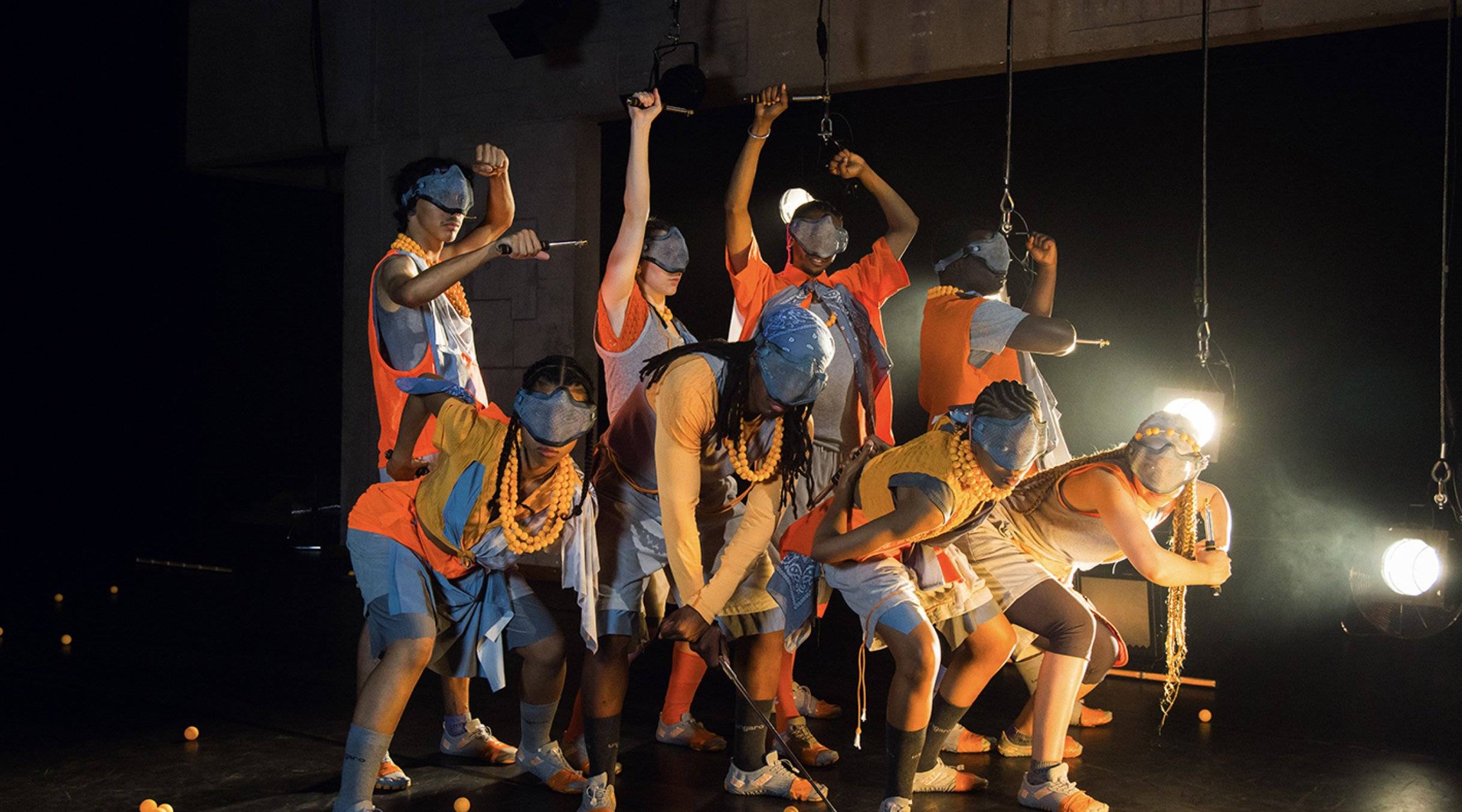
When I take my seat and take a look at the stage, it promises a sense of playfulness. It is filled
with orange ping-pong balls that seem to move their own accord. They could be clown noses
or an invitation to some kind of game.
When the dancers arrive, they step on the balls and they burst cheerfully: POP!
Like bubble gum bubbles, or that popping candy I remember from childhood, bought from
the pick-and-mix bins, crackling on the tongue. Suddenly I remember my best friend Pauliina
laughing, sticking out her tongue while the candy fizzed and popped on its surface. The
memory arrives unexpectedly, complete with its sound and texture. I catch myself smiling.
What?
The performance has barely begun, and I have already felt joy.
There is something joyfully simple in being surprised by the balls scattered across the floor.
Surprise itself is often joyful: surprise parties, unexpected encounters. Yet the popping can
also feel strangely violent, like a minefield one hesitates to step into. Suddenly it is no
longer funny at all.
I also find myself wondering whether it hurts when the dancers step on the balls. I try
to observe their faces for signs of pain.
The performers move back and forth across the space, smiling and then becoming serious
again. I notice that I am smiling too. Not deliberately. Watching them, I think about mirror
neurons. We unconsciously imitate the expressions and gestures of those around us.
Sometimes even our breathing and heartbeat begin to fall into the same rhythm. Perhaps
this is why joy can be contagious.
I will try to figure out whether joy is reaching me.
I am smiling a little already. At the very least, I find myself swaying along with the music
and the gestures.
The performance is clearly divided into sections. Between these episodes, moods and
movement vocabularies shift constantly. At times we seem to be on a construction site, at
others in an airport where the airport field worker shows the guidance. Sometimes I
recognize something distinctly ordinary and relaxed and playful in choreography.
The dancers use telescopic poles to conjure different worlds. At first, I perceive them as
walking sticks, their holders strolling across their territories. This image makes me think
about the Swahili term mzungu, used to refer to white people or more broadly any foreigner.
The word derives from the Swahili verb zunguka, meaning "to wander" or "to go around".
Historically it was used for European explorers and later missionaries moving through East
and Central Africa and exploring their conquered lands. Perhaps that history left a slightly
mocking undertone in the word itself.
Then, suddenly, the telescopic poles become swords in a fencing scene, or weapons balanced
on the dancers’ shoulders. Again, play slips toward danger. Once more the atmosphere shifts
abruptly. Joy turns violent. The costumes hint at this as well. They are playful
and contain elements of games and make-believe, yet there is also something military about
them. Play becomes reality, until it transforms into something else again.
Solos emerge in quick succession, and individual movements spread and infect the group.
Joy is contagious. It is a powerful social glue.
Then everything stops, and we hear refreshing, cleansing rain. Rain that unites and washes
over all of us. A moment it feels that we all breath the same air.
The performance ends, and I wonder: Did I catch joy? Did my mirror neurons do their work?
Perhaps.
Did the performance wake my neurons of joy? I am not entirely sure. But somewhere between
the popping balls, the rain, the music and the dancers’ gestures, something reached me.
Perhaps joy is not a solution. Perhaps it is simply a brief easing of the weight. For a moment,
the world feels lighter to carry.