Frascati Theater, 05.06.26
Crunch. Crunch. Crunch. These are the opening sounds of Ana Pi’s electric dance piece Atomic Joy, choreographed to CHASSOL’s live composition. The eight blindfolded dancers start by walking up and down the stage in a column-like movement, crunching and breaking down bright orange balls as they go, and at random. The balls look like something that could be found in one of those corner shops that sells everything, packaged in a plastic transparent container, ready to take to the park to play table tennis with. They look like they have purposefully been spray painted bright orange and their colour matches parts of the dancers’ costumes. I can hear the sounds of the balls as they crack and deflate, as well as the patters of the dancers’ feet on the ground. They make deliberate, repeated movements to crush the balls as they walk in their individual paths. The balls bounce against each other and roll across the stage, sometimes slowly and sometimes at a rapid pace, as the dancers’ feet change their flow. There is a satisfying joy about watching the orange balls get broken down and moved across the stage, interacting with each other and changing their rhythms, but there is also a strangeness and uncomfortableness in the act of destroying them.
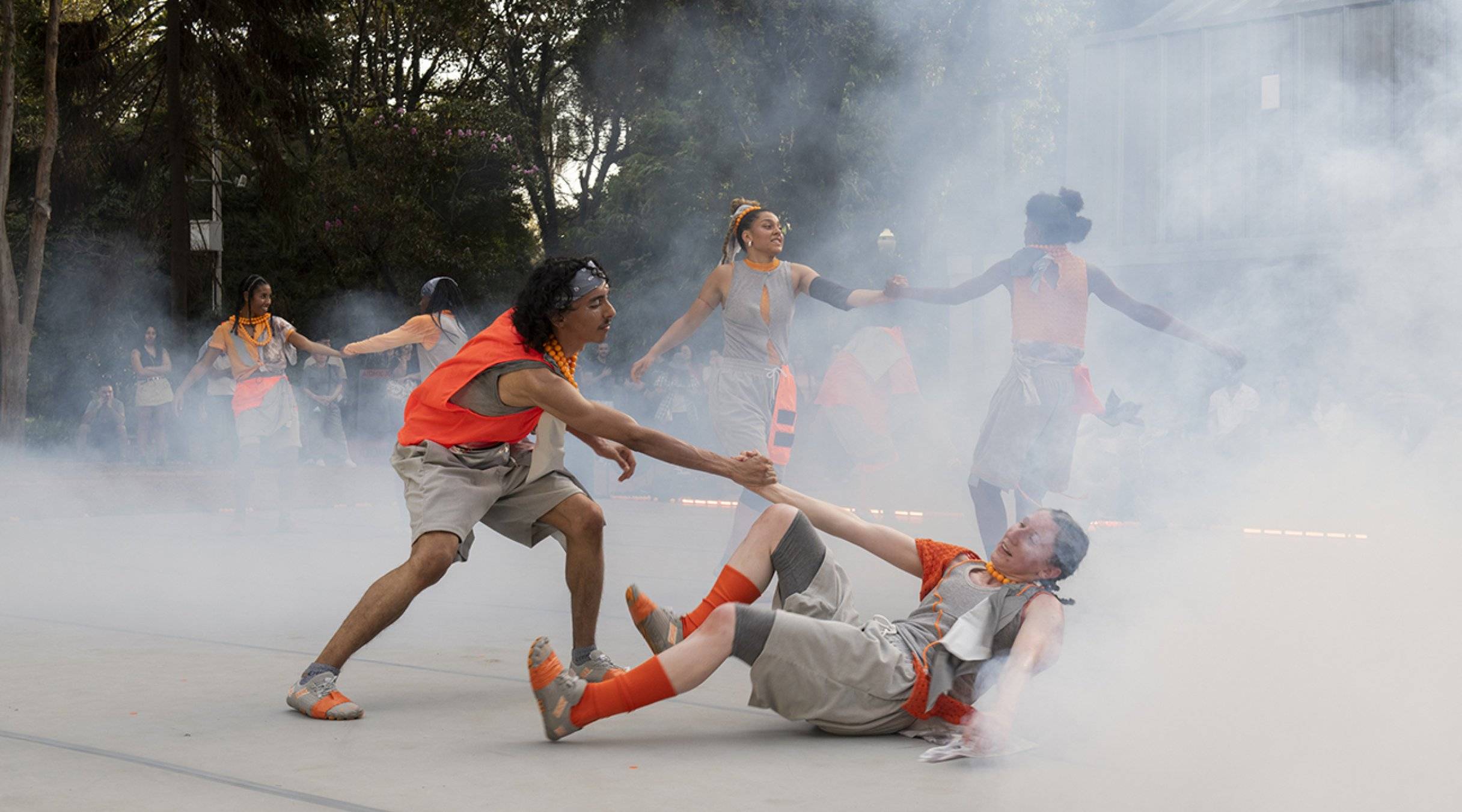
A little later in the performance, there is a moment where the melodic sounds that accompany the dancers start to shift, and the audience begins to hear the chinks and clinks of a mechanic, metallic creation, all while the balls keep fizzing across the stage. Elements, atoms, and materials come together to make something mechanical and constructed, that seems alien to joy. It is shown through the dancers’ bodies as they line up in a machine-like image but also through the live music composition that moves effortlessly between different types of noise. Soon after, the stage becomes a grey, smoky landscape. I can see the smoke thickening, but I also smell it intensely as it envelops the dancers in its fog. One dancer remains in the light, yielding orange fire and turning it into a mesmerising dance sequence. I can no longer see the dancer, just orange.
All of the dancers wear a kind of grey armour on top of their bright orange clothes. It’s as if their joy is constricted – by weaponry and by violence. There are moments of metal being built and yielded, of cutting and crunching, and of reenacted violence, as Ana Pi seeks to emulate the energy of dance battles and create a space for resistance. I start watching myself watching the violence, which is performed through rigid bodily shapes and harsh sounds, and through choreographed fights using different forms of weapons. Then I start watching the audience watching it. I notice how the audience members next to me are breathing in a similar pattern to me, and to the dancers, I think. I know that these eight young dancers come from the Paris street dance scene. And I know that Ana Pi draws on practices from the Trans-Atlantic African diaspora, where movement is passed through generations, often in times of struggle. I wonder where the audience member next to me comes from. I start thinking about where I come from.
Then joy erupts. A dancer starts smiling. I start smiling. I start laughing. The audience member next to me starts laughing. The dancers’ movements are slow, and soft. It feels like they are taking care of every part of their body and everything that their body is doing. Their feet are smiling too. Their hips definitely are. And their knees too. They dance individually, and also in groups, each going where their body leads them. The crunching is quieter. But then sometimes loud. Joy is loud.
I do not know how loud atoms inside the body are. But in a final moment, when the eight dancers come together, and suddenly start doing the same choreography at the same time, they feel louder than ever. It is a simple act, but now I can hear the precise sound of their feet touching the ground at exactly the same time as the seven other people that surround them, and their hands touching their bodies in precisely the same place at the same time, and with care. There is so much joy in this collective, resistant act. I do not notice the grey so much in this moment, everywhere I look there is orange and it is bright.